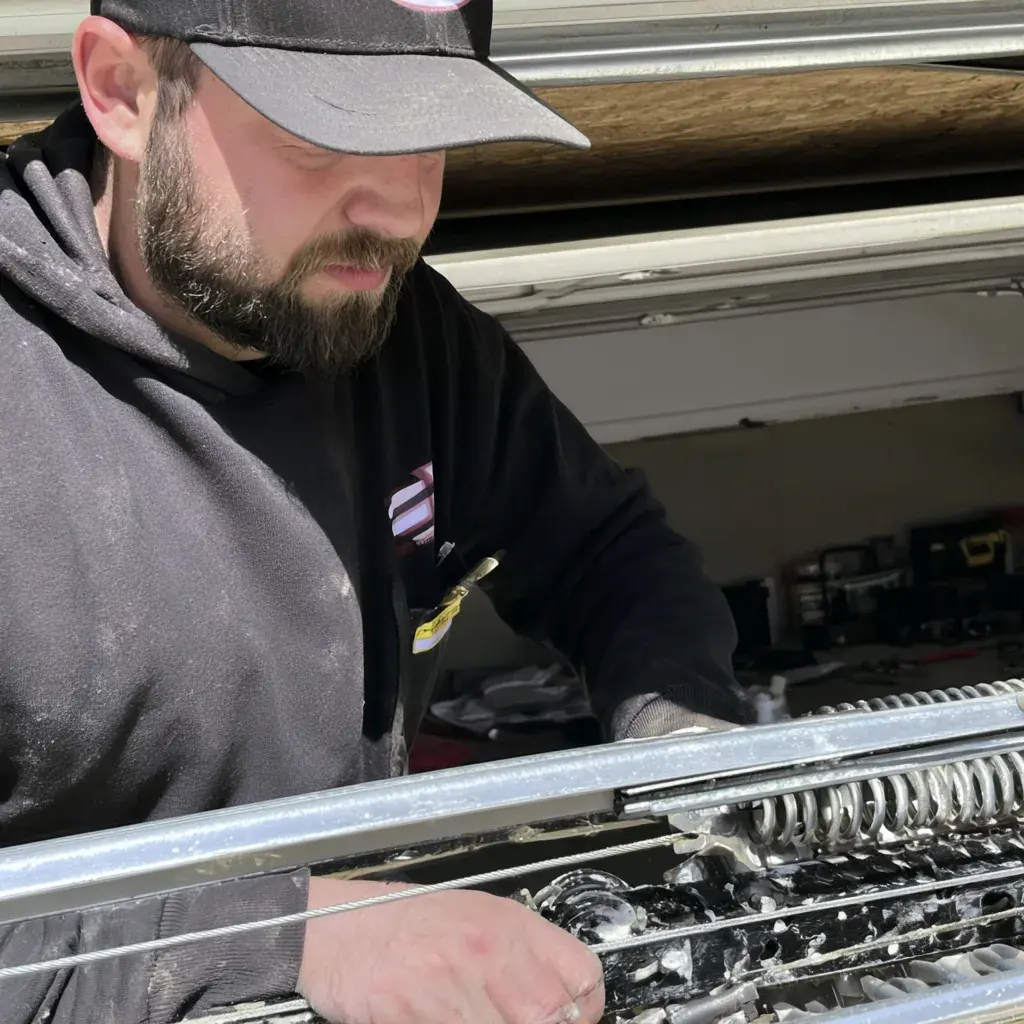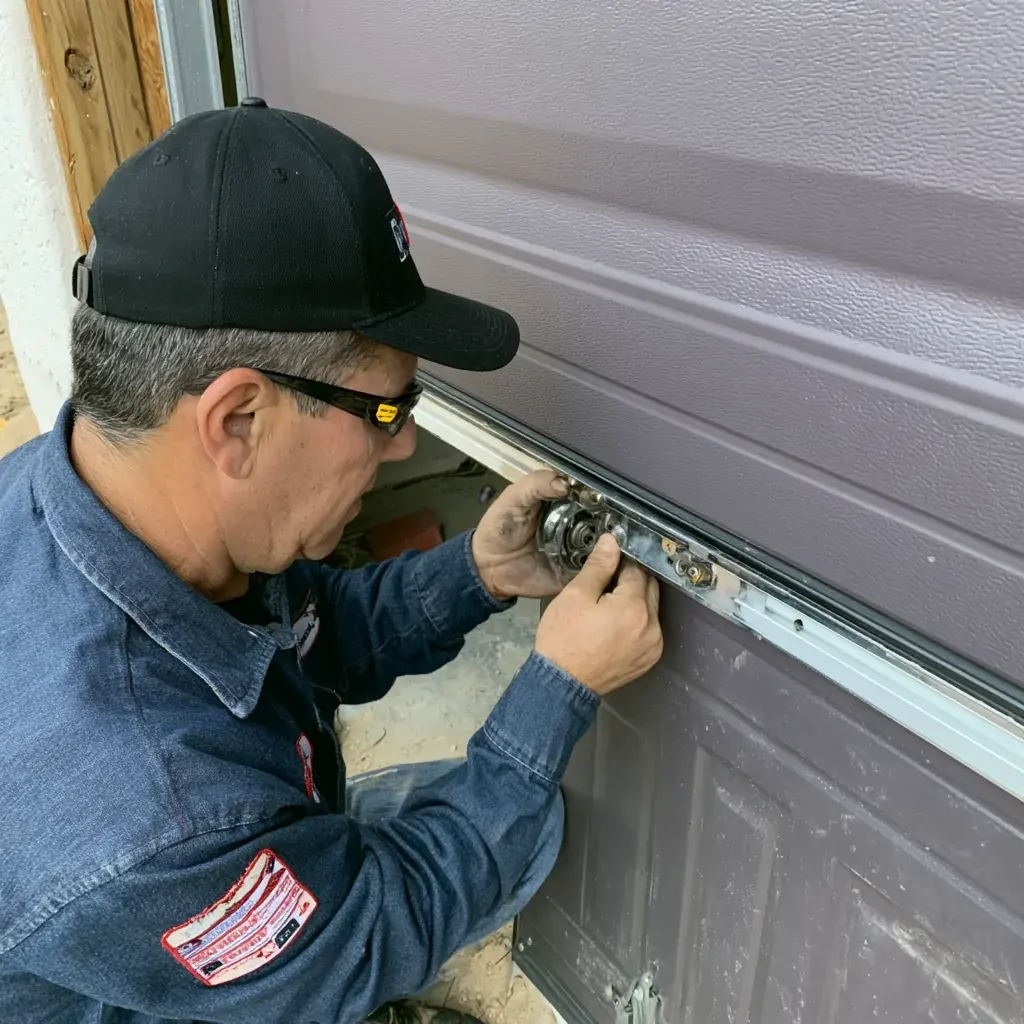
A garage door opener humming without any lift is a common call in Franklin, from Cool Springs condos to older homes near Downtown Franklin. The motor has power and is trying to work, but something inside the drive path is blocking the pull. That gap between sound and motion almost always traces to one of a few mechanical parts, and figuring out which one narrows the fix fast.
Listen for Where the Hum Sits
Walk into the garage and watch the rail while someone triggers the opener. If the hum comes from the motor head and the trolley never slides, the problem sits inside the unit itself, likely the gear and sprocket. If the trolley moves but the door does not follow, look at the arm connecting trolley to door, or at the spring that should be sharing the weight.
A Stripped Gear Inside the Head
Open the opener head and you will find a small gear and sprocket assembly that the motor shaft turns to move the chain or belt. That gear is often nylon, chosen so it wears out before the motor itself takes damage. Once it strips, the shaft spins freely and the sprocket never catches. You will hear the hum, maybe see the gear cover rattle, but the door on your Franklin home stays put every time.
A Snapped Chain or Belt
A Snapped Chain or Belt Plenty of homes around Old Town and Fieldstone Farms still run chain-drive openers, since the extra noise rarely bothers anyone in a detached garage. A chain that has stretched, jumped a link, or a belt that has split lets the motor turn without anything left to pull the trolley. You may hear a faint rattle or nothing at all before the hum starts.
A Sheared Trolley Connection
The trolley rides the rail and joins the chain or belt to the arm that bolts onto the top of the door. On many homes around Ladd Park and Berry Farms, that trolley connector is plastic and ages faster than the metal parts around it. When it shears, the opener carriage can travel along the rail with nothing pulling behind it, so the motor keeps running while the door itself never leaves the floor.
When the Spring Gives Out
Above the door, torsion springs carry most of the actual weight, with the opener only meant to guide that motion along. If a spring has lost its coil tension or snapped, the opener motor has nowhere near enough force to lift the door on its own, so it hums under the load and goes nowhere. This is common in older Franklin garages near Historic Downtown, where springs have had decades to fatigue.
Extension Springs on Older Homes
Extension Springs on Older Homes Some of the older streets near downtown Franklin and Del Rio Pike still have doors running extension springs, which stretch along the horizontal track instead of coiling above the opening. These springs weaken gradually rather than snapping all at once, so a door can go from merely heavy to immovable over several weeks. By the time the opener starts humming and going nowhere, the spring has usually been failing for a while.
A Capacitor Losing Its Punch
A capacitor inside the motor housing stores the extra charge needed to start the motor turning under load. As it ages, that capacitor holds less charge, and the motor gets just enough current to buzz but not enough torque to spin the gear and sprocket. This shows up more in humid Middle Tennessee summers, when heat inside a closed garage near Grassland or Westhaven can wear capacitors down faster than mild weather would.
Grit and Drift From Long Driveways
Longer driveways feeding into garages around Governors Club and Laurelbrooke carry grit and fine debris up on tires and shoes, and that material works into the chain, belt, and rail over time. Combined with clay soil that shifts slightly with Franklin's wet spring months, tracks can drift out of alignment, adding drag right as the gear or spring is already struggling to keep up.
Not the Same as a Silent Opener
A humming opener is a powered opener, which rules out a tripped breaker, a dead circuit board, or a wiring break, since none of those let the motor make any sound at all. That distinction matters because a silent, dead opener points toward the electrical panel or the unit's control board, while a humming one points toward something mechanical, the gear and sprocket, the trolley, or the springs, that the electricity is reaching but cannot move.
Test the Door by Hand First
Before assuming the worst, pull the manual release cord and try lifting the door yourself. If it rises smoothly on its own and holds partway up without dropping, the springs are still carrying their share of the weight, and the problem sits inside the opener itself. If the door feels heavy, drops fast, or will not stay put, stop there. That is spring tension gone, and it is not a safe repair for a homeowner near Carothers Parkway or anywhere else in Franklin to attempt alone.
Watch What the Trolley Does
A cold snap in Middle Tennessee can thicken grease on the rollers and rail overnight, and a door near Ladd Park or Sullivan Farms that sat through a hard freeze may drag just enough to make a marginal gear or capacitor finally give out. It is rarely the cold alone causing the failure, but it is often the push that turns a slow decline into a sudden stop.
Dealing with this in your home?
Franklin's clay soil swells after storms rolling through Cool Springs and settles again once things dry out near the Harpeth River, and a garage door track anchored to a slab or crawl space foundation shifts right along with it. Homeowners near McKay's Mill or off Del Rio Pike often notice the door binding on one side first, right when the ground moves.